
How Mauritius priced out a generation, part 2: starting pay, degrees, our parents' homes and inequality
Mauritians are richer than their parents were, on average. But more than half of employees earn Rs 25,000 a month or less, nearly one in five young people looking for work has none, and a first home now needs more than twice the typical household's income. Part 2 of 2 looks at pay, education, what it would take to own what our parents owned, and inequality.
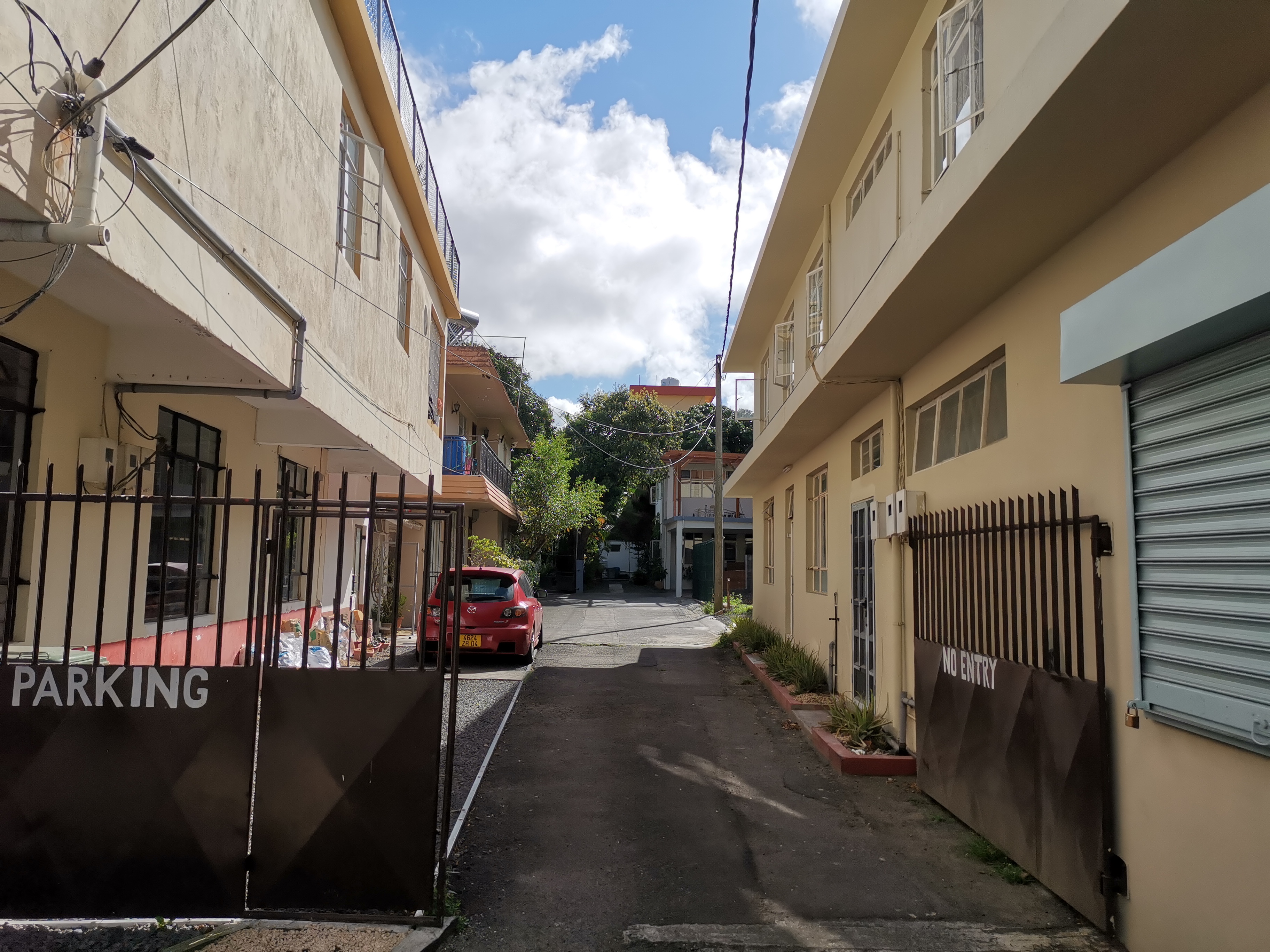
Photo: Z thomas, CC BY-SA 4.0
In short
The average hides the start. Average monthly earnings were Rs 46,229 in March 2026, but the legal first-year pay of a textile worker, a hotel waiter or a receptionist is Rs 17,000 to Rs 21,000, and more than half of employees earned Rs 25,000 or less in 2025. Among 16-to-24-year-olds looking for work, 19.3% have none.(1, 2, 4, 5)
Degrees are cheaper, but not free of cost. Public universities charge no tuition for a first degree, so households spend less on education than in 2017. But secondary pupils' private lessons cost 25% more than in 2023, a year abroad in Canada costs over Rs 1 million, and the share of indebted households with an education loan rose from 5.8% to 13.2%.(7, 10, 11)
Richer than our parents, except for the home. After taking out price rises, the typical household earns about 70% more than in 1991/92 (our calculation). But on the 40% repayment rule, a Rs 6 million first home needs about Rs 105,000 a month, 2.3 times the median household's income. Even with home prices frozen at their 2024 level, wages would need about nine years of 2025-style rises to get back to the 2018 ratio (our calculation).(11, 15, 17)
Income gaps narrowed; wealth did not. Income inequality is at its lowest in the official series (Gini 0.370 in 2023), and poverty fell. But an estimated 60% of wealth is held by the richest 10%, poverty is now highest among children and the young, and rising home prices reward those who already own.(11, 13, 14)
The average hides the start
Part 1 ended on good news: on average, pay has kept ahead of everyday prices. The trouble is the word "average". Average monthly earnings in firms with ten or more workers were Rs 46,229 in March 2026, but averages are pulled up by the best-paid.(1) Statistics Mauritius figures quoted by L'Express in December 2025 showed that more than half of employees earned Rs 25,000 a month or less.(4)
Young people mostly start at the bottom of that ladder. The national minimum wage, the lowest pay an employer may legally offer, is Rs 17,745 a month since January 2026 (Rs 17,110 plus the Rs 635 salary compensation; our calculation).(3) The legal first-year pay set for many common jobs is close to it: Rs 17,110 for a textile factory worker, Rs 18,723 for a hotel waiter and Rs 20,999 for a receptionist in 2025, and about Rs 23,600 for a bus driver or a private-sector nurse.(2)
Where you work matters more. Average earnings were Rs 74,676 in finance and insurance and Rs 67,815 in information and communication, but Rs 37,557 in hotels and restaurants and Rs 31,177 in textiles.(1) And first you need a job. In the second quarter of 2026, 19.3% of 16-to-24-year-olds who wanted work had none, against 8.8% of 25-to-29-year-olds and 5.5% of all ages; the young make up more than a third of all the unemployed.(5) One in five 15-to-24-year-olds was neither working nor studying nor in training in 2024, the World Bank says.(6)
What an education costs now
The usual way up that ladder is education, and here there is real good news. First degrees at public universities are free of tuition; students pay an administrative fee, Rs 10,000 a year at the University of Mauritius.(9) Partly as a result, households spent less on education in 2023 than in 2017: Rs 1,303 a month on average, 3.3% of their budget, against Rs 1,433 and 5.0%. It was the only part of household spending that fell.(7)
Other costs have not stood still. The price of private lessons, the after-school tuition many pupils take, rose by 25% for secondary pupils and 20% for primary pupils between 2023 and October 2026, while all prices rose by about 15%.(11) And many young people still study abroad: 7,815 Mauritian students were abroad in 2024-25, most in Australia, France, Canada and the United Kingdom. A year in Canada, with living costs, comes to 33,000 to 38,000 Canadian dollars, more than Rs 1 million.(10)
Families borrow to pay for it. Among households with a loan, 13.2% had an education loan in 2023, up from 5.8% in 2017; the average repayment was Rs 6,867 a month.(7)
Does a degree still pay?
Statistics Mauritius does not publish what people earn by level of education, so there is no official answer to the question every student asks. The clues point both ways. The sectors that hire graduates pay about twice what textiles or hotels pay, and in government service a secondary educator earned Rs 64,632 a month on average in 2025 (provisional), against Rs 24,595 for an office attendant.(1, 2)
But a degree is no guarantee of a job. In the second quarter of 2026, about 8,600 of the 32,000 unemployed, 26.9%, had studied beyond secondary school, up from 24.0% a year earlier.(5) And many young graduates look abroad: in a survey published by Afrobarometer in December 2024, 73% of Mauritians aged 25 to 34 said they had thought at least a little about emigrating, mostly to find work.(12) When the young and skilled leave, the cost of their education leaves with them.
What our parents had, and what it would take now
Are today's thirty-year-olds really worse off than their parents? On income, no. The Household Budget Survey has measured household income since 1986/87. Once price rises are taken out, the median household earned about Rs 26,550 a month in 1991/92 in today's rupees (2023 prices), and Rs 45,060 in 2023: about 70% more, with fewer people to share it (our calculation).(11)
On the home, the picture flips. Our parents' generation largely owns: 90.4% of households owned their home in 2022.(16) No official index of home prices goes back to their youth, so no one can say exactly how many years of pay a house cost in 1990. What we do know is the recent gap: between 2018 and 2024 home prices rose by 117% and wages by about 42%.(15)
So what would it take to catch up? Three ways to see it, all our calculations. On the 40% repayment rule from part 1, a Rs 6 million first home needs a household income of about Rs 105,000 a month: 2.3 times what the median household earned in 2023. If a bank wanted a fifth of the price upfront, Rs 1.2 million, a household saving a fifth of the median income, about Rs 9,000 a month, would need 11 years. And even if home prices had stopped rising at their 2024 level, wages would need about nine years of rises like 2025's (4.9%) just to get back to how affordable homes were in 2018.(8, 11, 17)
None of this means young people cannot buy. Many will, with two incomes, family land, help from parents or an inheritance. That is the point: getting a home now depends more on what your family already owns, and less on what you earn.
How unequal is Mauritius?
That brings us to inequality, and the answer depends on what you measure. Income first. The Gini index runs from 0 (everyone has the same income) to 1 (one household has it all). In Mauritius it rose to a peak of 0.414 in 2012 and fell to 0.370 in 2023, the lowest in the official series. The richest fifth of households got 43.4% of all income in 2023 and the poorest fifth 6.2%, about seven times less.(11)
Poverty fell too. Statistics Mauritius counts a person as relatively poor when their household income, adjusted for its size, is below half the national median; that share fell from 10.4% of people in 2017 to 8.4% in 2023. But it is now highest among the young: 15.7% of children under 16 and 10.6% of 16-to-24-year-olds, against 3.1% of people over 60, whose pension and free services do most of the work. Without government transfers and free services, poverty among older people would be 15 times higher.(13)
Wealth, what people own rather than earn, is far more concentrated. The World Inequality Database estimates that the richest 10% of adults hold about 60% of household wealth, and the richest 1% about a quarter; these are modelled estimates, since Mauritius has no official wealth survey.(14) For most families, wealth means a house or land. When home prices rise faster than pay, those who already own get richer without lifting a finger, and those who do not own fall further behind. That, more than any jump in the price of bread, is how a generation gets priced out.
What it means for you
Picture Anaïs, 24, with a degree from the University of Mauritius that cost her family little in fees but years of private lessons before it. She has found a first job in an office in Ebène at Rs 28,000 a month. She still lives with her parents in Curepipe, and her friends are talking about Canada.
Her pay is well below the average and far below what a first home needs. Living with her parents lets her save; if she puts aside Rs 6,000 a month, she will have about Rs 720,000 in ten years (our calculation, before interest). Her best route to owning is likely to be a second income, a family plot or a smaller first home, not her salary alone.
The one thing to do: whatever your age, start saving a fixed amount each month for a deposit, even a small one, and check every year whether you qualify for state help, such as the first-home registration duty exemption (on the first Rs 6 million of a house or apartment).(18)
What this series covered, and what is left
With this second part the series is complete. Part 1 covered what things cost: homes, land, loans, rent and the everyday basket. Part 2 covered what young people earn, what education costs and whether it pays, how far today's young adults are from what their parents owned, and inequality of income, poverty and wealth.
Some questions have no official answer yet: how many adults aged 25 to 34 live with their parents, what people earn by level of education, how much homes cost before 2018, and what share of homes are sold to foreign buyers. If Statistics Mauritius publishes them, we will come back to this story.